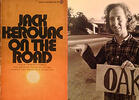
Josh Brolin talks about being inspired by On the Road in Ebs Burnough's Kerouac's Road: The Beat of a Nation, now in theaters. It was a like a dream for Brolin, reading the book that launched the Beat Generation with its publication in 1957. He got a motorcycle and headed out on the highway.
It was similar for me, though I never got a bike. I read On the Road while I was at Lehman College in the Bronx and from that point on decided I needed to tour around America. This was the early '70s.
Born in Lowell, MA in 1922, Kerouac moved to New York to attend Columbia University, where he met Allen Ginsburg and other members of the burgeoning beatnik movement. After a stint in the service during World War II, he started criss-crossing the country. In Denver, Kerouac met Neal Cassady, who he dubbed Dean Moriarity in On the Road. A larger-than-life adventurer, Cassady became Kerouac's muse and best friend.
Reading On the Road was like a map of the country with terrific text. The opening passage reads:
"I first met Dean not long after my wife and I split up... With the coming of Dean Moriarty began the part of m life you could call my life on the road. Before that I'd often dreamed of going West to see the country. Always vaguely planning but never taking off. Dean is the perfect guy for the road because he actually was born on the road."
My first two summers during college were spent zig-zagging around the country. Like Kerouac, and perhaps influenced by him, I didn't graduate and traveled instead. In the fall of 1974, I headed out West again, this time not as a summer student having fun but as a full-time wanderer. Me and Ed (also a dropout) bought a cheap car and took off, as Kerouac advised.
By then I'd also read Visions of Cody, which Kerouac wrote in 1951-1952 (it was posthumously published in 1972), right on the heels of On the Road. It's a deeper dive into the Kerouac-Cassady relationship, with Cassady now called Cody Pomeray. From these two books I conjured a trip that would take us to Denver, San Francisco and New Orleans, all hot spots on the Beat trail.
I spent a week with friends who'd just eloped to Denver. We stayed in a boarding house on Colfax. It was very Neal and Carolyn Cassady and Kerouac, with me on the couch. Were we playing roles?

We took to San Francisco like the seals at Fisherman's Wharf. After a trippy New Year's Eve, we headed South and then East to New Orleans where the law was waiting for us, just like in Easy Rider.
These memories come pouring back as I assess the movie. It mostly covers On the Road and the significance of travel, getting away, experiencing more in life than what you have at home. Back then plane travel was fairly new and expensive. Gas was cheap and highways were being built. You could get to San Francisco from New York in three days on Interstate 80.
Burnough takes the middle ground on Kerouac's legacy. Singer Natalie Merchant rightly questions the male-dominated beat culture and points to the misogyny expressed in some of Keroauc's words. TV host W. Kamau Bell reminds that a Black man couldn't have done what Kerouac did at that time in American history. On the other hand, Kerouac dug jazz and turned many white kids onto it.
According to Kerouac's biographers Ann Charters and Joyce Johnson (both are featured), he was averse to celebrity and after the first wave of success with On the Road quickly became a raging alcohol, another reason to view him negatively.
"Like Hemingway, Kerouac lived what he wrote and wrote what he lived."
To fill out the film and show how universal the desire to travel is, Burnough introduces a solo woman pulling a trailer, a couple in a van and a high-school student heading off to college. The value of these stories in context with Kerouac is debatable, but they do modernize the movie.
Kim Jones is reminiscent of Frances McDormand's Oscar-winning character as Fern in Nomadland (2020). It's just her and her dog on a mission to connect with estranged family. The couple – Cuban-American vet Faustino and Black woman Tenaj – love van life. The student Amir is leaving the mean streets of Philadelphia behind to attend Morehouse College in Atlanta. His mom and sisters join him on the ride South.
But ultimately it all tracks back to a writer who found his voice in the post-war era, a time of suburban expansion and urban sprawl. The roads weren't so crowded then and no one could find you in the vast open spaces of the West. Before computers and cell phones, you could get lost in America, literally. And there was a freedom in that, which Kerouac dutifully explored.
I miss those times. Yes, it was a privilege to traipse around the country in cheap cars or on Greyhound buses, to skip school and look for America at tent rivals, pool halls and passion plays.
I say be kind to Kerouac, and do not diminish his literary and cultural impact. Like Hemingway, he lived what he wrote end wrote what he lived. Hemingway made it to 61. Kerouac died in 1969 at 47, the result of a damaged liver and a broken heart.
MORE MOVIES
• Top 30 Stoner Movies (2024)
• The Bike Riders (2024)
• On the Road (2012)
See more of the latest CelebStoner news!
 ×
×