Nancy Kurshan lived and breathed the radical movements of the '60s and '70s as a founder of the Yippies, member of the Weather Underground and powerful female among the mostly male hierarchy. In this except from her new book, Levitating the Pentagon and Other Uplifting Stories: A Life in Activism, Kurshan reviews the movie The Trial of the Chicago 7, which featured her boyfriend Jerry Rubin and fellow activists Abbie Hoffman, Tom Hayden, David Dellinger, Bobby Seale, Rennie Davis, John Froines and Lee Weiner and their lead attorney William Kunstler in a zany court case presided over by Judge Julius Hoffman from 1969-70.
*****
In 2021 Aaron Sorkin’s The Trial of the Chicago 7 was released for streaming on Netflix. The movie is entertaining, sometimes moving and often funny. But it played fast and loose with the facts. As the reader knows, I was in the room where it happened. And I wasn’t the only woman. The Conspiracy office was largely run by women and women were the most ubiquitous in the courtroom. Some were partners of the defendants; some were there as political activists and legal workers. Others were both personal friends as well as political and legal workers. Women were generally the grunts, doing all the day-to-day grind work in the office. That was true with regard to the Chicago 8 as well as other movement centers of activity. We were also a critical element in the courtroom dynamic. Prosecutor Schultz referred to us as “those girls who are always with the defendants.” Author John Schultz (no relation) insists that we “girls”:
“… had, in fact, intimidated many of the marshals. Their insistence on their rights, their vocal protest, their laughter, their way of acting forthrightly and with a purpose when the spirit of declaration moved them, made many of the marshals think two or three times before 'causing an uproar' by attempting to eject any one of them. (John Schultz, No One
Was Killed, The Democratic National Convention 1968, p. 284)
Perhaps the guards appreciated our power, but the defendants certainly did not. We were the supporting cast. Without us, the play could not go on. Despite that essential role, the defendants and those around them often treated us women like rock band groupies.
The most astounding aspect of the trial was the resistance of Bobby Seale, and the Court’s physically gagging and binding him. Sorkin did a decent job in portraying that. The other incredible aspect, as I have described, was the Yippie defense, filled with imaginative, sometimes brilliant, testimonies from a dizzying array of people. There was not one word about that in Sorkin’s version. Tom Hayden was the only one consulted on this movie, and I can imagine this was his view of what mattered in the trial. It is also probably more consistent with Sorkin’s view of politics. But without the Yippie defense, the trial may never have become so widely known and there might not have even been a Sorkin movie.
"We might not have been out there in the limelight, but we were fighting just as hard, if not harder, than the men were to end the war and bring about a more just world. Our movement was shot through with male supremacy and with this, Sorkin inadvertently reminds us we have a long way to go."
Although the actors were great, Sorkin failed to reflect the essence of many of the characters. He showed Jerry as a violence-provoking buffoon, one who let a female FBI agent get close to him in the midst of what we had put our hearts and souls into for much of the year. The only woman who was next to him the whole time was me. And I knew Jerry’s faults as well as anyone, which is finally why I left him. But I also knew his strengths. He had tremendous courage. Not Rambo courage. It was ridiculous to see him in the film talking about Molotov cocktails. He couldn’t even make a smoothie! But he was brave. He stood up three times to the House Un-American Activities Committee (HUAC). He organized audacious protests and was brilliant at utilizing the mass media.
The one that Sorkin really got wrong was Dave. Dave was an incredibly firm pacifist and his behavior in the courtroom exemplified this. Remember, with a second to decide, it was Dave who stepped up and stood between Bobby and the guards when they went after Bobby. He was jailed for that, not for defending himself. And he would never have slugged a guard. Sorkin also missed a most important aspect of Kunstler’s courtroom behavior. What made him so different from many lawyers was that he had the greatest respect for his “clients,” and most especially for Dave. And who didn’t? We all loved and admired Dave, even if his stand as a World War II conscientious objector was difficult to come to terms with. I doubt Kunstler ever criticized Dave for his CO stance. And if he did, it would not have been in that offhand way.
Rennie Davis was not such a naive stick character. He might have looked like he was just an all-American guy, but he had traveled to North Vietnam, and Madame Binh considers him to this day as her adopted son. Although I’m pretty sure it was actually Dave who read the names of the war dead in court, I was glad the film gave Rennie some respect by having him compile and read the names. But the unacceptable distortion by Sorkin was excising the names of the Vietnamese dead which had been read alongside the American names. Vietnamese lives mattered to us! That’s what this was all about. How could Sorkin play it differently?
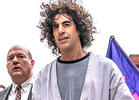
Sasha Baron Cohen did a reputable job, although Abbie was more charming, and both funnier and more serious. He was as good as most standup comedians but was serious in his devotion to social change. He had previously participated in the Civil Rights movement and in later life he became an environmental activist.
I believe Tom was, at that time, also a serious revolutionary. He made a mistake and misread the nature of the trial. He felt that the most important thing was to get the trial over with and go back to doing the real work that was needed to change the country. That’s a reasonable argument. But it wasn’t a reasonable trial, and it had been an opportunity to reach and mobilize people around the country and the world. Tom was slow to get that and perhaps didn’t respect the Yippies enough to hear it sooner.
"I knew Jerry’s faults as well as anyone, which is finally why I left him. But I also knew his strengths. He had tremendous courage. Not Rambo courage. It was ridiculous to see him in the film talking about Molotov cocktails. He couldn’t even make a smoothie!"
The Judge was meaner and more idiosyncratic than portrayed. He really was a nasty piece of work. The prosecutors were also creeps, and we did not have cordial conversations with them as depicted.
The missing element in the film was the rest of us, by which I mean the thousands of anti-war activists who came to the trial and waited out in the cold for hours to get into the trial. And all of us who joined the support effort and participated from the audience and were threatened or removed or arrested. Those folks were the engine that drove the anti-war movement, and among them were many WOMEN. In the absence of any of us being depicted in the movie, the fictitious burning of bras in Lincoln Park was demeaning. The only other women in this film were the phone-answering Bernardine (a ridiculous throwaway to Bernardine of SDS/Weatherman fame?) and the fictitious amorous undercover cop who “replaced” me. We might not have been out there in the limelight, but we were fighting just as hard, if not harder, than the men were to end the war and bring about a more just world. Sorkin could have had Anita, Tasha and me burning judges robes instead of bras. Our movement was shot through with male supremacy and with this, Sorkin inadvertently reminds us we have a long way to go.
Nonetheless the Sorkin film will now no doubt enhance the legacy of the Yippies. Even before the movie, many a high school and college student contacted me for their research projects, and Googling the Youth International Party produces 5,150,000 sites (unconfirmed) that one can roam through.
Excerpted from Levitating the Pentagon and Other Uplifting Stories: A Life in Activism by Nancy Kurshan, Published by Three Rooms Press, 2026.
See more of the latest CelebStoner news!
 ×
×